
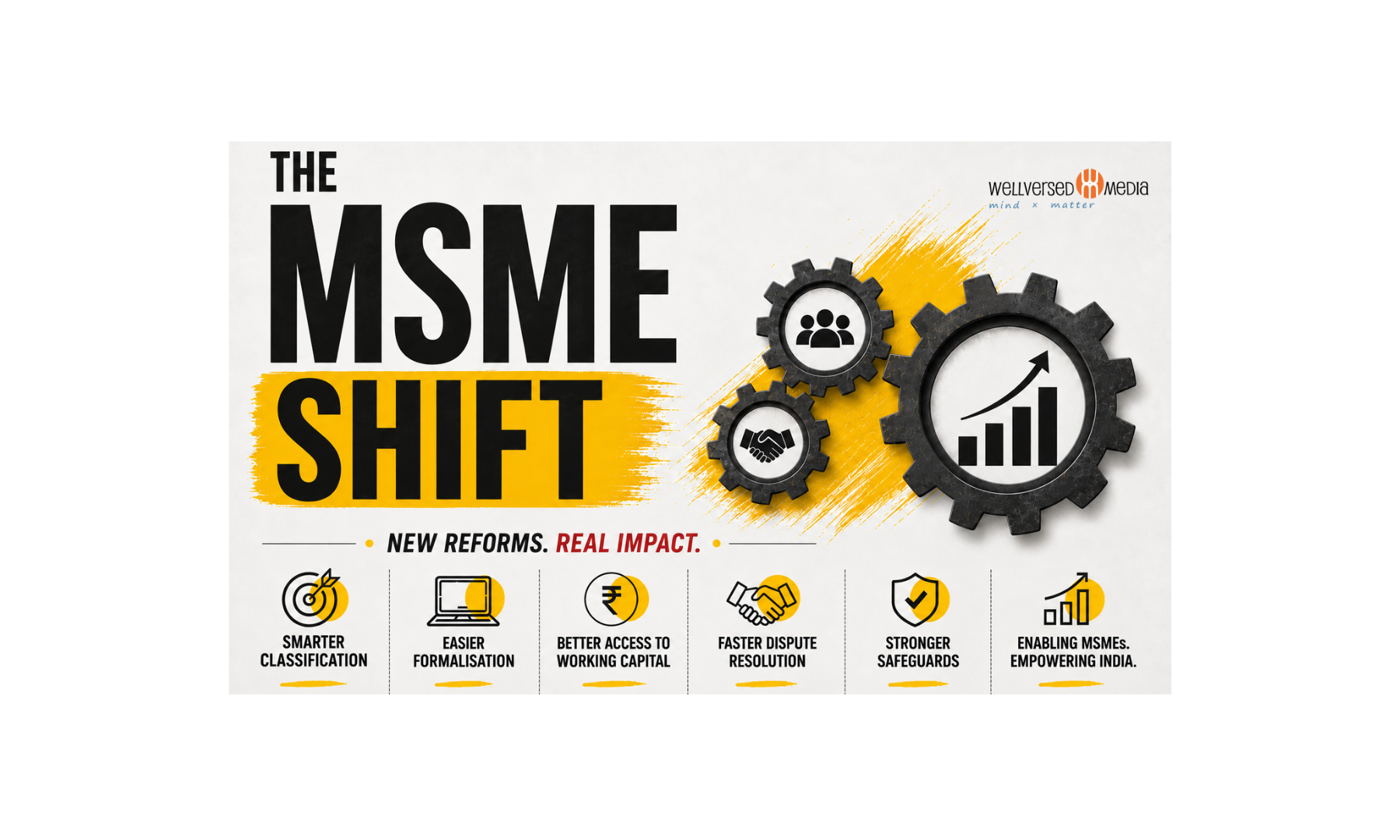
What the 2026 Amendment Bill Could Change
India’s growth story is, in no small measure, an MSME story. With more than 7.47 crore enterprises spanning manufacturing, services and trade, MSMEs represent one of the country’s most widespread and powerful engines of economic activity. The sector contributes around 31.1% to India’s GDP, 48.58% of total exports and 35.4% of manufacturing output. Beyond these numbers, MSMEs drive employment, entrepreneurship, local industrial development and global competitiveness, making their growth and resilience critical to India’s ambition of realizing the vision of Viksit Bharat. Given the scale and significance of this contribution, the policy environment surrounding MSMEs becomes critical to India’s broader growth trajectory.
It is in this context that the MSME Development (Amendment) Bill, 2026 assumes importance, proposing several changes that could reshape the way MSMEs are classified, formalised, financed and supported. Our key takeaways from the proposed amendments point to a stronger focus on simplifying formalisation, refining MSME classification, improving access to working capital, addressing delayed payments, strengthening dispute-resolution mechanisms and facilitating recovery of outstanding dues. Collectively, these changes could help reduce regulatory and financial constraints, enabling MSMEs to operate more efficiently, access support, manage cash flows and scale their businesses.
1. A Broader Basis for MSME Classification
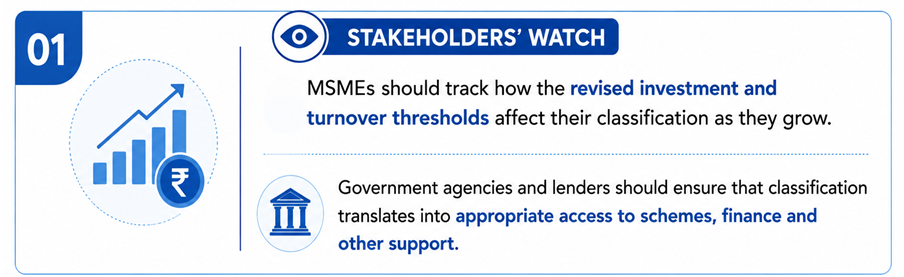
One of the key proposed changes is the revision of the MSME classification framework, which will consider both investment in plant and machinery/equipment and turnover.
The two parameters capture different dimensions of an enterprise. Investment reflects its productive capacity and capital intensity, while turnover indicates its actual business activity and market performance. Considering both therefore provides a more comprehensive picture of the scale of an enterprise.
For MSMEs, this could result in a classification system that more accurately reflects their operations and growth trajectory. It can also support financial benchmarking and business planning, while helping enterprises identify the government schemes, credit facilities and other support mechanisms relevant to their category.
The revised framework could also have implications for procurement. A clearer understanding of an enterprise’s size and capacity can help corporate and public-sector buyers assess MSME suppliers more effectively, potentially improving opportunities for vendor qualification and participation in formal supply chains.
2. Digital Registration Could Simplify MSME Formalisation
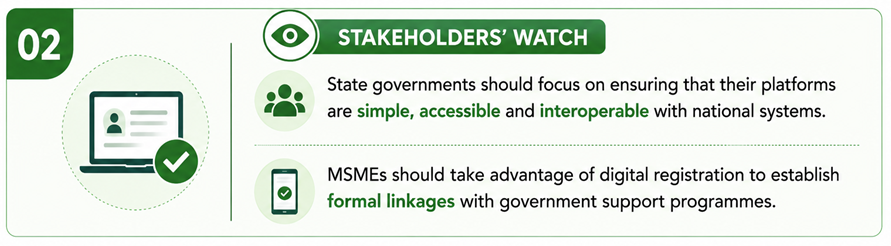
The Bill proposes to make MSME registration free and voluntary through a national platform, while allowing States to establish their own digital platforms.
This could reduce the administrative and financial barriers associated with formalisation, particularly for micro enterprises. A simpler digital process can also improve the visibility of MSMEs within government systems and make it easier to identify enterprises eligible for various support measures.
The proposed State-level platforms could further decentralise the registration process. State governments could use these platforms to identify MSMEs within their jurisdictions and connect them with State-specific schemes, incentives, procurement opportunities and support programmes. Better integration between national and State-level systems could also strengthen coordination and improve delivery of benefits.
3. TReDS Can Strengthen MSME Working Capital
The provisions addressing delayed payments are particularly significant because unpaid invoices can lock up working capital and constrain an MSME’s ability to operate and expand.
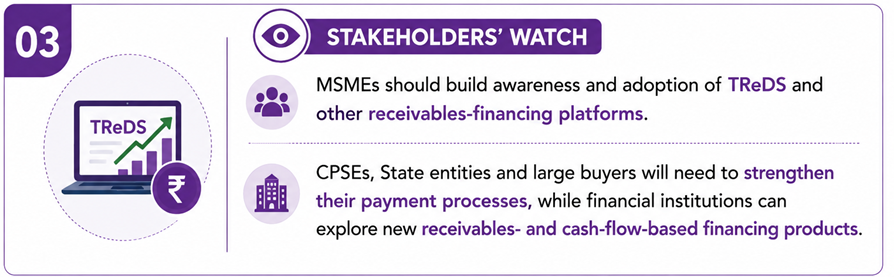
The Bill provides for mandatory settlement of invoices from MSMEs by Central Public Sector Enterprises (CPSEs) through the Trade Receivables Discounting System (TReDS). States may similarly require their public-sector entities and other specified organisations to use TReDS.
Greater use of TReDS can help MSMEs convert receivables into cash more quickly, reducing the period for which funds remain locked with buyers. Improved liquidity can help enterprises meet operating expenses, pay suppliers and employees, and invest in expansion without relying excessively on additional borrowing.
The wider adoption of digital receivables platforms, cash-flow-based lending and early-payment solutions could complement TReDS and further improve access to working capital.
4. Strengthening MSEFCs for Faster Dispute Resolution
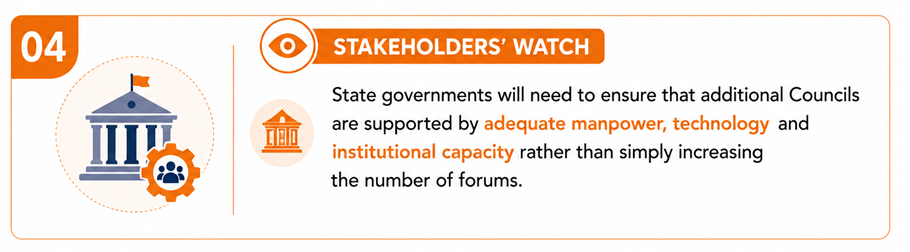
The Bill proposes to strengthen the Micro and Small Enterprises Facilitation Council (MSEFC) mechanism by allowing States to establish multiple Councils and provide them with improved physical and digital infrastructure and trained personnel.
This could address capacity constraints that contribute to delays in resolving disputes related to unpaid MSME dues. Multiple Councils could distribute caseloads more effectively and potentially make the system more accessible to enterprises across different regions.
For MSMEs, a more adequately staffed and digitally enabled MSEFC system could reduce the time and resources required to pursue payment-related disputes.
5. Online Mediation and Arbitration Can Reduce the Cost of Disputes
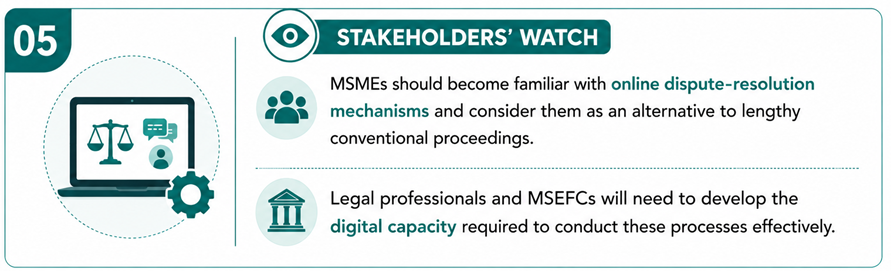
The proposed introduction of online mediation and arbitration, supported by specified timelines, could significantly change how MSMEs approach commercial disputes. Mediation is expected to be completed within 90 days, with additional timelines applying where disputes proceed to arbitration.
For small businesses, conventional dispute resolution can involve significant travel, documentation, legal expenses and time away from business operations. Online proceedings can reduce these costs by enabling parties to participate remotely.
Mediation can also provide a less adversarial mechanism for resolving disputes, which may be particularly valuable where MSMEs want to preserve relationships with customers, suppliers or other business partners.
Most importantly, faster resolution can enable businesses to recover outstanding payments sooner and reduce the period for which working capital remains tied up in disputes.
6. Interim Payments Could Protect MSME Cash Flow
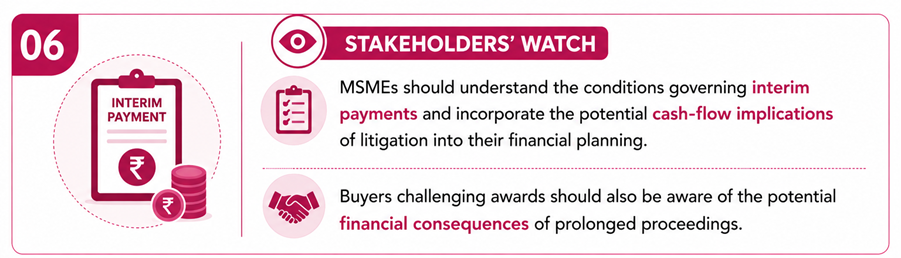
The Bill proposes an important safeguard where an arbitral award is challenged in court. If proceedings continue for more than six months, the court must direct payment of at least 50% of the awarded amount to the MSE supplier, subject to prescribed conditions.
This provision addresses a critical issue: even after successfully obtaining an arbitral award, an MSME may have to wait for an extended period if the award is challenged.
Receiving a substantial portion of the awarded amount while the case continues could provide MSMEs with much-needed liquidity and reduce the disruption caused by prolonged litigation.
A New Operating Environment for MSMEs
Taken together, the proposed amendments point towards an MSME ecosystem that is more digital, accessible and financially resilient. The changes span the entire MSME business cycle, from classification and formalisation to access to finance, payment realisation and dispute resolution. For stakeholders, the Bill should therefore be viewed not merely as a set of regulatory amendments, but as a potential shift in how MSMEs engage with government, financial institutions, buyers and dispute-resolution mechanisms. Ultimately, the impact of these reforms will depend on effective implementation, digital accessibility, institutional capacity and widespread adoption across the MSME ecosystem.