
As bilateral trade stands at USD 3.36 billion, Togo is emerging as an important partner in broadening India’s economic engagement with West African markets.
Green and white alternating stripes make up the flag of Togo, with a white star in a red background nestled in the corner. Seen together, Togo’s flag symbolises the most notable aspects of the West-African nation. While the red represents the determination and tenacity of the country as it overcame its obstacles, the green and yellow signify the resources that Togo prides itself upon the most; agricultural abundance and mineral wealth, respectively. These resources, driven primarily by Togo’s mining of mineral phosphates, have fuelled Togo’s development and solidified Togo’s presence in global value chains.
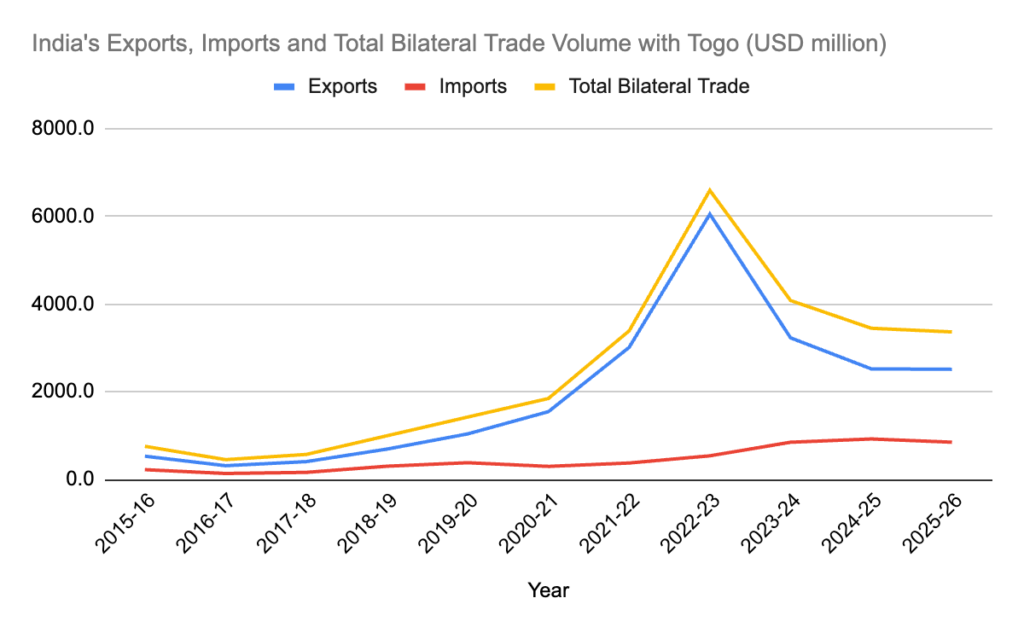
As India’s total trade with Africa nears the USD 100 billion milestone, Togo plays a growing role in the India-Africa bilateral trade climate. Bilateral trade between the two countries stood at USD 3,363.64 million in 2025-26, made up of Indian exports worth USD 2,512.37 million and imports worth USD 851.27 million, recording a 2.42% decrease year-on-year due to Indian exports of oil and cereals decreasing.

Source: Government of India
India’s trade with Togo has expanded greatly over the past ten years, with bilateral trade reaching a peak in 2022-23, driven by rising demands for mineral fuels and oils caused by the Russia-Ukraine war. Since then, it has decreased as India’s mineral fuel and oil exports to Togo decreased and has now entered a period of relative stability, decreasing by only 2.4% between 2024-25 and 2025-26.
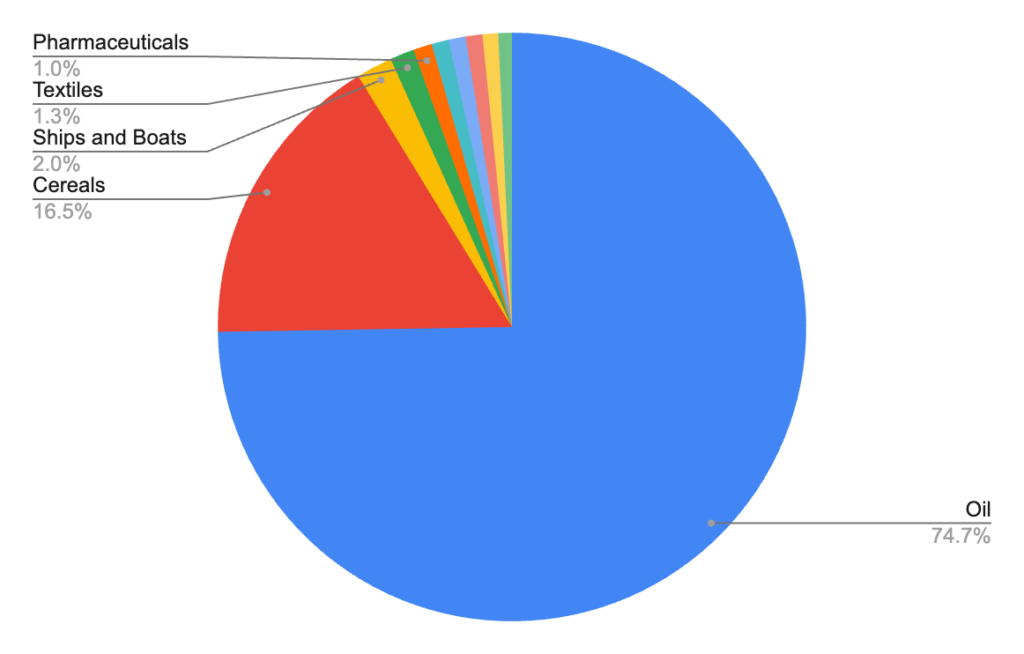
India’s exports to Togo are primarily composed of oil and petroleum products, which made up 70% of exports in 2025-26. India also exports cereals, ships and boats, textiles, pharmaceuticals, plastic and vehicles to Togo.
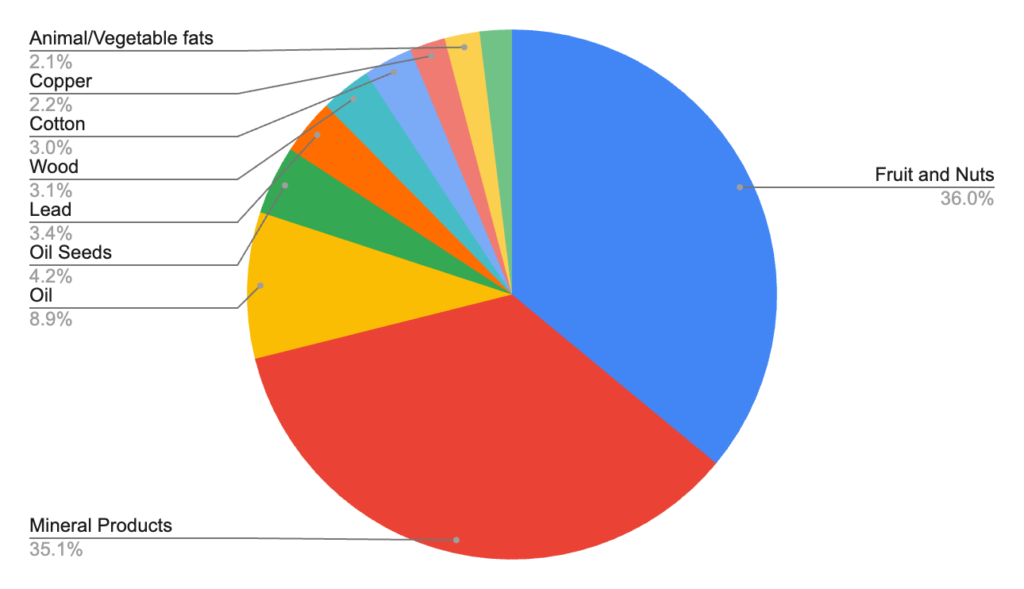
At the same time, India is Togo’s single largest export market, exporting mainly phosphates, fruit and nuts, oil, oil seeds, lead and wood articles. In 2025, phosphates made up 16.2% of Togo’s total exports, with India being the main destination of these exports.
India’s exports to Togo (2025-26)
Source: Government of India
India’s imports from Togo (2025-26)
Source: Government of India
Phosphates: The Backbone of Bilateral Trade
Building on these trade statistics, phosphates has become a major bilateral trade item, serving as a critical resource for India’s agricultural sector. Agriculture contributes to 18% of India’s national GDP and supports the sustenance of nearly 46% of the population. In order to sustain this industry, India imported USD 18 billion worth of fertilisers in 2025-26, with demand rising steadily. However, geopolitical tensions in the Middle East and the subsequent disruption of the Strait of Hormuz have threatened to disrupt India’s fertiliser imports.
In recent years, geopolitical developments have heightened concerns about the vulnerability of these supply chains. The Russia-Ukraine war had already exposed the risks associated with excessive dependence on a limited number of suppliers, prompting India to diversify its sources of fertilizer and raw materials. This shift was reflected in a significant increase in imports from Togo, which rose by 57.2% between 2022-23 and 2023-24. More recently, tensions in the Middle East and disruptions affecting shipping through the Strait of Hormuz have further reinforced the need for resilient import networks.
Indian fertiliser manufacturers have already incorporated Togolese phosphate into procurement planning, with Togo playing a crucial role in India’s fertilizer security strategy as a substitute for imports from other regions. Now, with disruptions in the Strait of Hormuz due to the war in Iran, diversification of imports and building resilience in the face of conflict are chief concerns, providing one of many incentives for the broadening of India’s trade relationship with Togo.
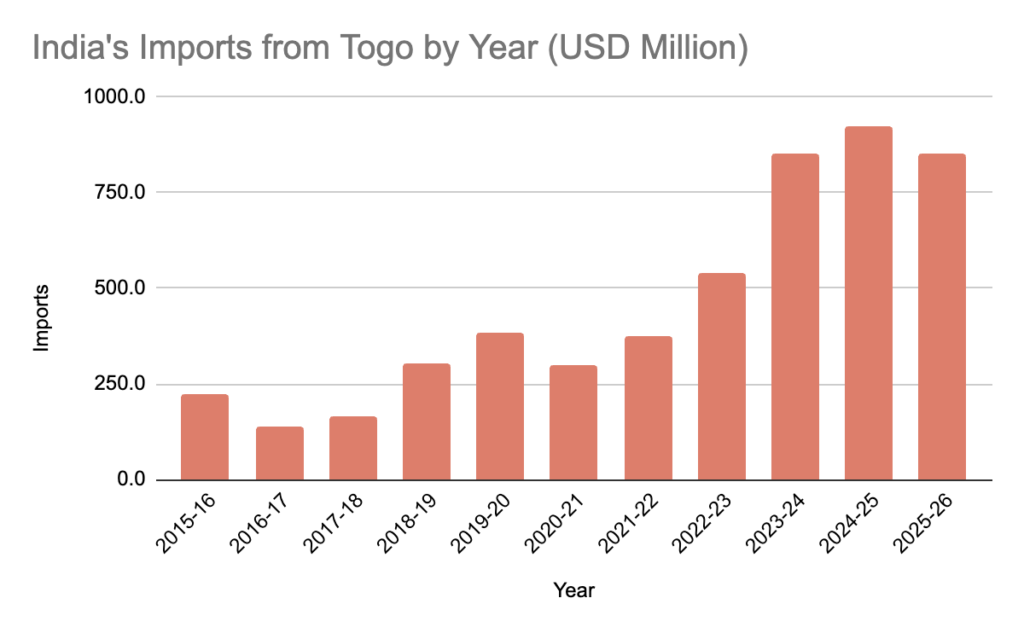
Source: Government of India
The Port of Lomé
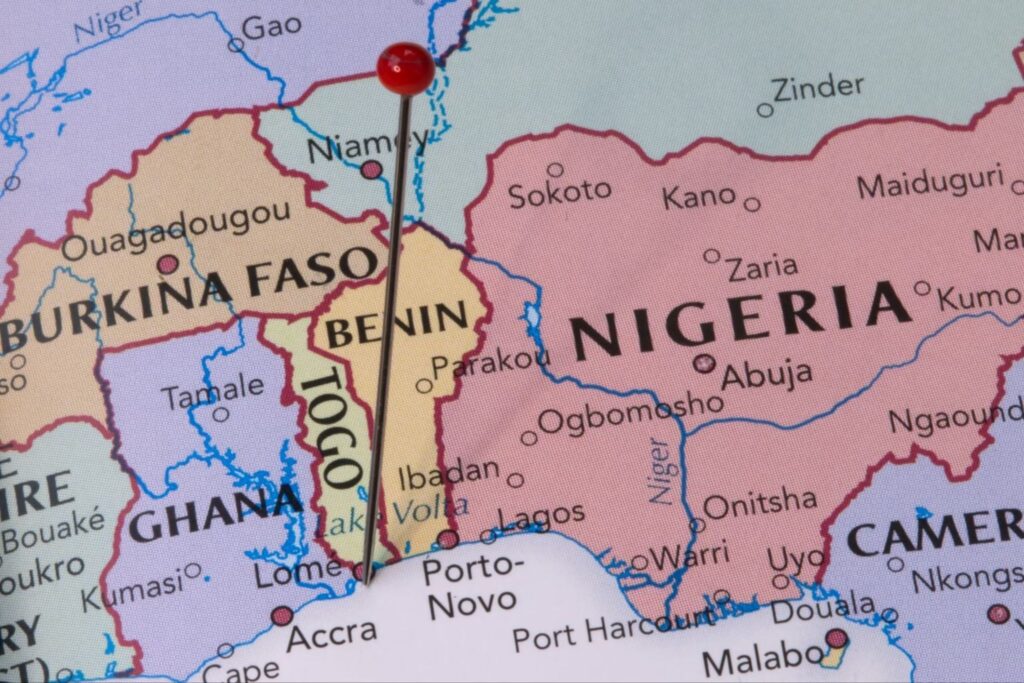
For Indian businesses, Togo’s value lies not only in what it exports but also in its role as a commercial and logistics hub for West Africa. The Port of Lomé has an annual throughput of over 30 Mt and is Africa’s fourth-busiest container port. The port drives 70% of Togo’s economic activity and has attracted attention from countries such as the US and Russia for access to African markets such as Burkina Faso, Niger, Mali and Nigeria. Disruption in shipping through the Strait of Hormuz has led to Togo’s positioning of the Port of Lomé as an alternative trade and logistics centre, with the port emerging as an important route to facilitate African trade and energy flows.
Indian companies operating through Lomé can use Togo as a distribution base for neighbouring countries, including several landlocked economies that depend on the port for external trade. This creates opportunities for Indian firms in logistics, warehousing, shipping, agro-processing, pharmaceuticals, construction materials, and consumer goods distribution. The port’s strategic location and growing infrastructure also reduce transportation bottlenecks and improve supply-chain efficiency, making Togo an attractive platform for Indian investors seeking a scalable entry point into West African markets.
The DFTP Scheme and Expanding Trade Opportunities
India’s Duty-Free Tariff Preference (DFTP) Scheme, implemented in 2008, has provided an additional impetus to trade relations with Togo by granting preferential market access to exports from around 48 Least Developed Countries (LDCs). The scheme provides duty free/preferential market access on about 98.2% of India’s tariff lines, lowering barriers to trade. As an LDC, Togo is among the African countries that benefit from these preferences, allowing its exporters to access one of the world’s largest consumer markets on more favourable terms.
While the growth of India-Togo trade has been driven primarily by commercial demand for commodities such as phosphates, the DFTP scheme complements these market forces by creating a more conducive trading environment. The benefits of the DFTP scheme are further reinforced by the implementation of the African Continental Free Trade Area (AfCFTA), which aims to reduce trade barriers across the continent and create a more integrated African market. The DFTP helps Togolese goods enter India more easily while the AfCFTA helps goods and businesses move more easily within Africa. Therefore, an Indian company in Togo gains access not just to Togo, but potentially to a much larger regional market.
Business Opportunities for Indian Investors
India has extended seven Lines of Credit worth approximately US $183 million bilaterally to Togo since 2011 for various development and infrastructure projects. These include rural electrification, power transmission network extension, agriculture and the supply and installation of healthcare equipment. In addition to the opportunities for investment in Togo’s fertiliser industry and in logistics and transshipment, Togo presents many fruitful opportunities in the sectors of logistics, fertilisers, infrastructure and technology for Indian firms looking to invest in Africa.
These broader development partnerships and investment initiatives are complemented by targeted industrial and agricultural projects that further enhance opportunities for Indian businesses in Togo. The Adétikopé Industrial Platform (PIA) located north of Lomé offers integrated services like warehousing, container storage, customs facilities, and single-window administrative support, focusing on textile production, agro-processing and logistics. The Togolese government is also actively developing agricultural zones, such as the Agropole of Kara, which focus heavily on expanding agricultural value chains of soy, sesame and rice, providing investment opportunities for Indian agricultural companies.
Togo’s agricultural sector represents a massive investment opportunity, contributing over 40% of the national GDP and employing nearly two-thirds of the workforce. The country possesses 3.6 million hectares of cultivable land (60% of its territory), yet only 1.4 million hectares are currently sown, leaving over 2 million hectares completely unutilised for expansion.
For Indian investors, Togo’s investor-friendly reforms significantly reduce the costs and administrative barriers associated with establishing and operating a business. The country’s streamlined online company registration process, digital trade facilitation platform (SEGUCE TOGO), and dedicated investment promotion agency (API-ZF) which maintains the Invest in Togo website, make market entry easier and more efficient. Additionally, the Investment Code and Free Zone Regime offer attractive fiscal and customs incentives, making Togo a competitive base for Indian companies seeking to access West African and regional export markets.
Taken together, Togo’s flag comes to represent not only the country but also stands as an image of hope, for a country that has much to offer the world. India’s partnership with Togo has the potential to shape this hope into concrete progress through development, with investment into a mutually beneficial bilateral relationship guiding the way.