
As oil production recovers from years of conflict and infrastructure disruptions, rising imports are creating new opportunities for India-South Sudan bilateral cooperation.
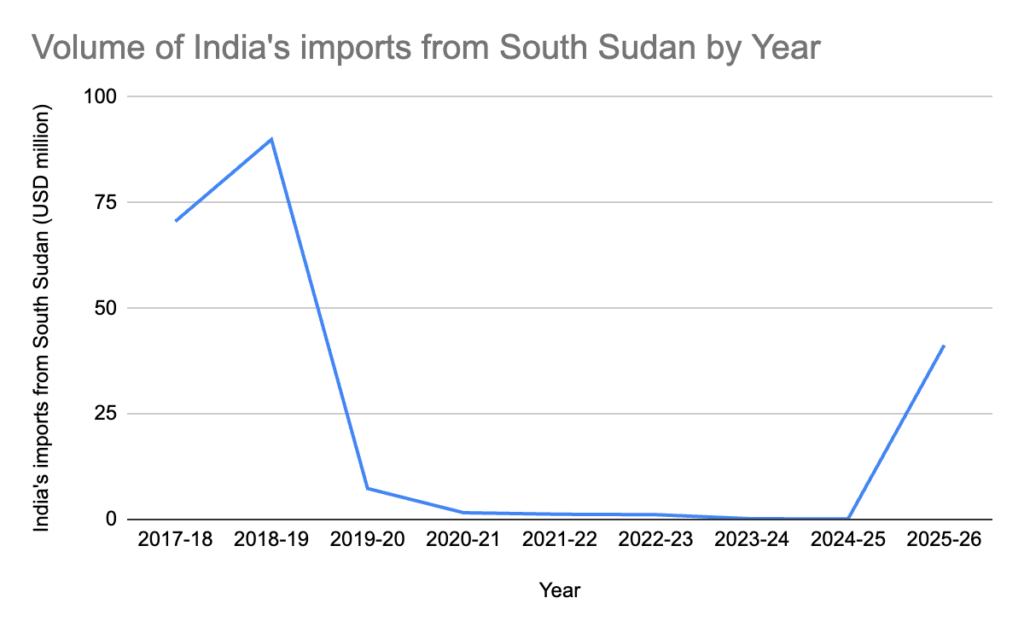
For much of the past decade, South Sudan’s oil industry has been defined by conflict and disruption and yet, recent trade data indicates that the country’s bilateral ties with India are gaining renewed momentum. Bilateral trade between the two countries rose from USD 21.21 million in 2024-25 to USD 72.9 million in 2025-26, recording a 243.7% increase year-on-year. While Indian exports increased steadily over this period, increasing from USD 21.26 million to USD 31.61 million, the drastic increase in bilateral trade can be attributed to the increase in imports from Sudan from USD 0.15 million to USD 41.29 million.
India primarily imports oil and timber from South Sudan, while exporting consumer and household goods, food items, pharmaceuticals and motorcycles and three-wheelers to the country. The increase of imports reflects the gradual recovery of South Sudan’s oil sector after a period of severe disruption caused by conflict and pipeline outages, creating new opportunities for bilateral economic cooperation.
| Year | 2017-18 | 2018-19 | 2019-20 | 2020-21 | 2021-22 | 2022-23 | 2023-24 | 2024-25 | 2025-26 |
| Imports (USD mn) | 70.56 | 89.97 | 7.33 | 1.59 | 1.23 | 1.13 | 0.16 | 0.15 | 41.29 |
The Sharp Disruption of South Sudan’s Oil Sector
The oil industry of South Sudan provides its country with its biggest source of revenue and foreign exchange earnings. However, the industry has faced various disruptions over the years due to civil conflict, operational issues and underinvestment.
The sharp dip in India’s imports from South Sudan from 2018-19 to 2019-20 can be attributed to the origin of the ongoing conflict in Sudan following the downfall of Omar al-Bashir’s 30-year dictatorship in 2019. Tensions escalated until the eruption of civil war in Sudan in April 2023 between the Sudanese Armed Forces (SAF) and the Rapid Support Forces (RSF), which has targeted critical oil infrastructure and jammed trade flows. Conflict and fighting in Sudan has complicated South Sudan’s export of oil since it has disrupted the selling of South Sudanese oil from an export terminal in Port Sudan. These disruptions are reflected in the trends of India’s imports from South Sudan, with import volume decreasing further from USD 7.33 million to USD 1.13 million from 2019-20 to 2022-23.
In February of 2024, the export of oil was disrupted further as part of the 1,400 km pipeline connecting South Sudanese oilfields to Port Sudan, and transporting 60% of South Sudan’s oil production, was damaged in an airstrike. Lengthy repair processes were required to fix the pipeline clogging and rupture, which could not be carried out due to the ongoing war. In the period of time from 2023-24 to 2024-25, South Sudan’s exports to India totalled only 0.31 million USD, reflecting the drastic impact of the damage to this pipeline upon Sudan’s international trade.
Recovery and Resurgence
Despite the tumultuous history of South Sudan’s oil industry, it was reported in January 2025 that repairs on the damaged pipeline had been completed, facilitating the export of oil exports from the country. Reflecting this change, South Sudan’s exports to India jumped from USD 0.15 million in 2024-25 to USD 41.29 million in 2025-26, with export volume increasing almost 275 times year on year. The repair was critical to addressing the country’s fiscal crisis, addressing government salary arrears and resuming crucial development projects.
As of May 2026, it was reported that the Greater Pioneer Operating Company (GPOC) of Sudan recorded a production level of 60,158 barrels per day, the highest output achieved in two decades. In spite of the setbacks and constraints of the past, South Sudan’s achievement of this milestone indicates the resurgence of the country’s oil industry and shows potential for greater output when backed by strategic investment.
Prior to the conflict, India’s imports from South Sudan were valued at USD 89.97 million, of which 86.1% was made up of oil imports. Although production remains below pre-conflict levels, the sector’s recent recovery points to significant untapped potential that could enable it to match or even surpass earlier output levels with sustained investment and support.
Rising Indian Demand
India is the world’s third-largest oil consumer and imports 88.6% of its crude oil requirements and ensuring access to stable supplies remains a key component of India’s energy security strategy. Recent geopolitical shocks including the US-Iran war, and subsequent disruptions in global shipping routes, have reinforced the importance of a diversified supplier base. South Sudan is one of several African oil producers including Algeria, Angola, Nigeria and others, that help broaden India’s import portfolio and growing imports reflect India’s willingness to engage with emerging suppliers.
As South Sudan’s oil sector emerges from a period of disruption, India is well positioned to contribute not only as a buyer of crude oil but also as a long-term development partner. Through investment, technical cooperation, infrastructure support, and private-sector engagement, India can play a constructive role in strengthening the resilience and sustainability of South Sudan’s most important economic sector as the country recovers from the effects of violence and instability.
Although South Sudan cannot rival major suppliers such as Russia, Iraq, or Saudi Arabia in terms of volume, its recovering oil sector offers India an additional source of crude at a time when diversification has become increasingly important. Given India’s heavy dependence on imported oil, even modest supplies from emerging producers can enhance supply resilience and reduce overreliance on a limited number of exporters.
Investment Opportunities
Existing Indian investments provide a strong foundation for deeper economic engagement with South Sudan. Since 2003, ONGC Videsh Ltd. has invested around USD 2 billion in hydrocarbon projects across Sudan and South Sudan. Indian-owned businesses are also active in sectors such as construction, hospitality, drilling services, printing, retail trade, and oilfield support services, with many supplying goods and services to UN agencies.
South Sudan’s recovering oil sector presents promising investment opportunities for Indian companies across the value chain. Years of conflict and underinvestment have left significant gaps in exploration, production, infrastructure, and oilfield services, creating demand for capital, technology, and technical expertise. Indian firms, particularly those with experience in energy and infrastructure development, could contribute to field rehabilitation, enhanced oil recovery, pipeline maintenance, storage facilities, and related engineering services.
Beyond the oil sector, South Sudan presents a range of opportunities for Indian businesses in sectors critical to the country’s reconstruction and economic development. Demand for affordable pharmaceuticals, medical equipment, and healthcare services also creates opportunities for Indian companies with established strengths in these fields. Additionally, South Sudan’s infrastructure deficit, including roads, power generation, telecommunications, and urban services, offers scope for Indian firms with expertise in construction and project development.