
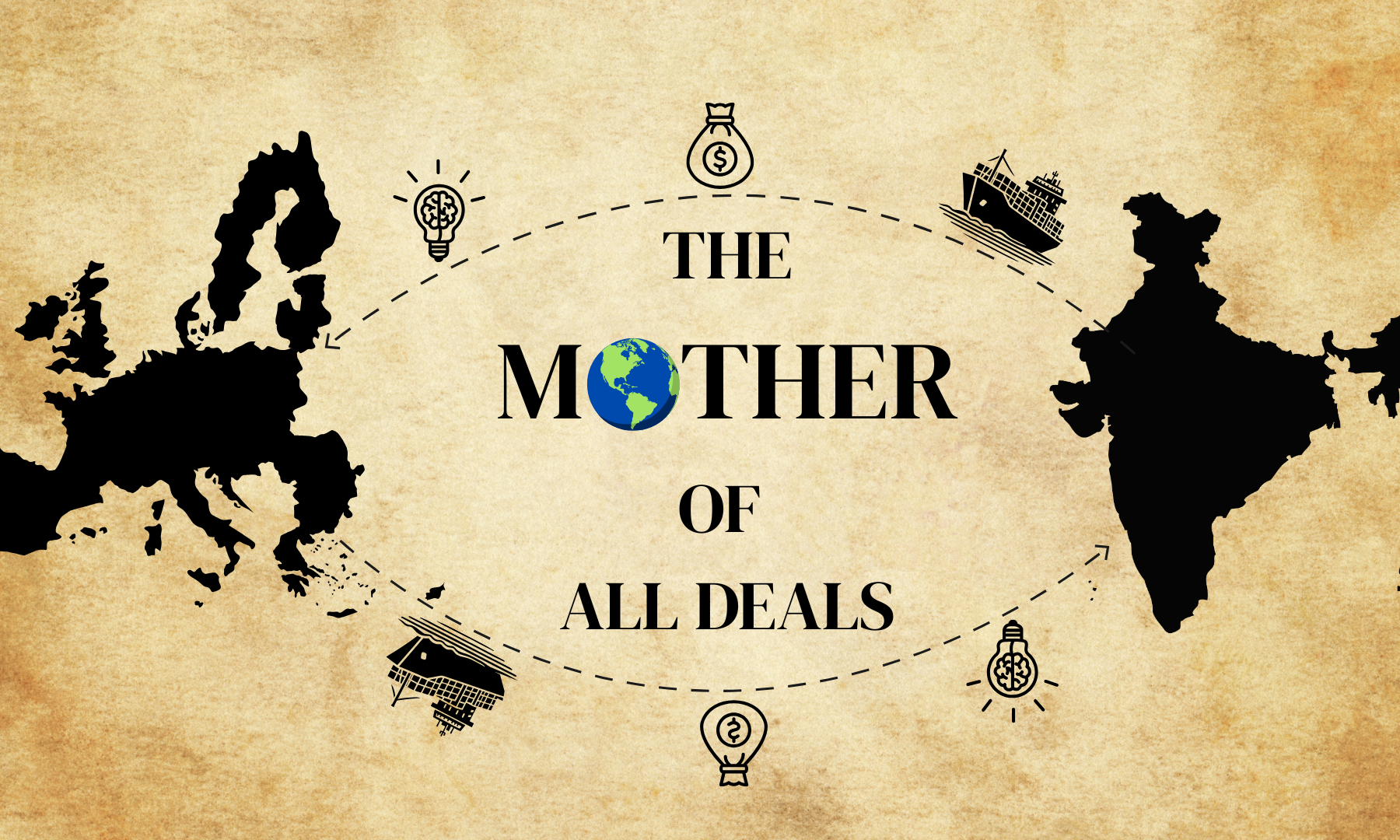
The India-EU FTA is far more than a conventional trade pact. It is both a geo-economic response to global fragmentation and a geopolitical statement of strategic convergence.
By Rajiv Raghunath
The great significance of the India-European Union Free Trade Agreement (FTA), finalised on January 27 during the India visit of European Commission President Ursula von der Leyen, may be understood from multiple standpoints — geopolitical alignment, geo-economic necessity, India’s experience with different other bilateral trade agreements, and India’s own broader long-term trade and development objectives. Taken together, these dimensions explain why the India-EU FTA is increasingly being described as the “mother of deals” in India’s trade diplomacy.
Independent Powers, Shared Strategy
Despite differences in economic scale and institutional structure, both India and the European Union are often viewed as emerging independent actors in a multipolar global order. The EU remains an economic heavyweight, yet its geopolitical influence has not fully matched its economic strength. India, on the other hand, occupies a favourable geopolitical position but continues to build the economic heft needed to shape global outcomes decisively. What brings the two closer is a shared emphasis on strategic autonomy and independent foreign policy decision-making.
India’s strategic outlook has historically been shaped by non-alignment and, more recently, by its leadership role in the Global South. Similarly, the EU has sought greater autonomy amid shifting power balances and evolving transatlantic dynamics. This convergence provides a strong geopolitical foundation for deeper economic cooperation. As a result, the FTA functions not merely as a trade instrument, but as a strategic mechanism to reinforce alignment between two actors seeking to operate independently within an increasingly fragmented global system.
Geo-economic Imperatives in a Fragmenting Global Economy
The global economic environment remains fragile, marked by slower growth, rising protectionism, and the growing risk of economic fragmentation. Projections of prolonged low global growth highlight the urgency of sustaining open trade and investment channels. Economies dependent on FDI and global value chains are especially vulnerable in such a scenario.
Against this backdrop, the India-EU FTA assumes geo-economic importance as a stabilising and de-risking instrument. For the EU, the agreement aligns with its broader strategy of diversifying trade and investment partners to reduce over-reliance on specific geographies. India offers scale, growth potential, and a relatively stable policy environment, making it an attractive long-term partner. For India, closer economic integration with the EU helps secure access to advanced markets, technology, and capital at a time when global investment flows are becoming more cautious and selective.
Addressing Market Access Asymmetries
From India’s perspective, one of the strongest geo-economic arguments for the FTA lies in correcting existing market access disadvantages. Indian exports to the EU historically faced higher tariffs compared to several other Asian countries that enjoy preferential access to the EU markets under different trade arrangements. This asymmetry has constrained India’s competitiveness in key labour-intensive and manufacturing sectors.
An FTA would significantly reduce or eliminate these barriers, enabling Indian exporters to compete on a more level playing field in one of the world’s largest and most sophisticated markets. For the EU, improved access to India’s expanding consumer base and evolving manufacturing ecosystem supports long-term commercial interests while also strengthening supply-chain resilience.
Leveraging India’s Evolving FTA Strategy
India’s historically cautious approach to FTAs has been shaped by concerns around trade deficits, domestic industry competitiveness, and uneven outcomes. However, recent agreements and ongoing negotiations reflect a more calibrated strategy, one that prioritises deeper market access, stronger rules, and alignment with India’s industrial and export ambitions. The India–EU FTA fits squarely within this evolved approach, offering opportunities for technology transfer, standards alignment, and value-chain integration rather than tariff reduction alone.
Trade as a Lever for Strategic Autonomy and Global Standing
Geopolitically, the agreement strengthens India’s strategic space at a time of heightened uncertainty. As power shifts and regional tensions reshape the global order, India seeks to diversify partnerships to avoid excessive dependence on any single bloc. The EU, facing its own strategic recalibration amid strained transatlantic ties and growing competition with China, similarly benefits from a deeper partnership with India.
The FTA thus serves as a platform for mutual strategic reinforcement, enabling both sides to hedge against geopolitical and economic volatility while advancing shared interests in a rules-based international order.
The India-EU Free Trade Agreement represents far more than a conventional trade pact. It is both a geo-economic response to global fragmentation and a geopolitical statement of strategic convergence. By addressing market access asymmetries, reinforcing supply-chain resilience, and aligning with broader goals of strategic autonomy, the agreement supports India’s ambition to integrate more deeply into global value chains while strengthening Europe’s diversification strategy. In this sense, the India-EU FTA stands as a cornerstone of India’s future trade architecture and a critical pillar of Europe’s evolving global engagement.